


Warm light bled from restaurant windows lining Dundas Street in Toronto’s Chinatown, illuminating the evening sidewalk. It was an unusually mild January night, and I was walking to a pub to meet a friend I hadn’t seen since university.
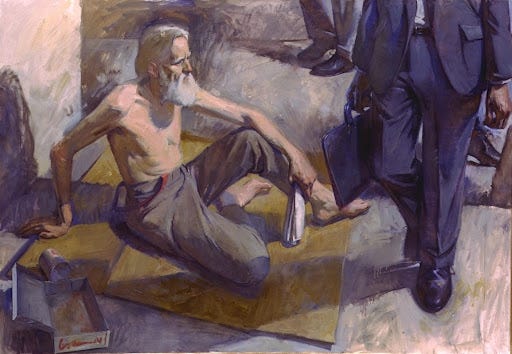
A homeless man with the hood of his winter jacket pulled down over his eyes began walking beside me. He was Chinese, probably in his thirties, though he looked decades older. A wispy white Fu Manchu moustache framed his mouth, which held less than a full set of gray and yellow teeth jutting in different directions.
He was sniffling and hunched over as he approached me. I felt my heart rate rise into my throat and my fists tighten. Walking half a pace behind to my left side, he started speaking. Stammering. Stuttering. Asking me to buy him food. He spoke fast, his words tied together by an unmistakable undertone of fear that he would be rejected again.
Suddenly, he dropped off. He was no longer walking beside me. I walked ten more metres then paused to look back.
He was prostrate on the ground. Bowing to me on his hands and knees, his forehead pressed into the grimy sidewalk. Begging me, a stranger, to buy him food.
He looked up and saw me ahead, staring back at him. In one of those brief feeling-not-thinking instinctual moments that shape our lives, I waved him towards me, “Okay, let’s buy you some food. Anything close by you like?” “The H-h-house o-o-of G-g-ourmet” he stuttered as he pointed across the intersection. We crossed the street and he led me inside a Chinese restaurant with glistening brown Peking duck and crispy braised pork ribs hanging on meat hooks in the glowing window.
He ordered. I paid.
As I walked out, leaving him to wait for his food, he stuck out his hand to shake mine. His hand was bloody and dirty, sickly looking. I ignored it wordlessly and walked out of the restaurant, shame washing over me as the crisp January air enveloped me once again.

I felt conflicted about sharing this story because a heart in the right place does not share about its own good deeds.
But to be clear, my charity track record is not good. Buying this man a meal was the biggest donation I’ve made in months. If you added up my giving for the last year, it would equate to less than ten cents a day. I’m not writing this for praise. If anything, I should be chastised for my selfishness.
I wrote this because I’m flawed but trying to be better.
After leaving the restaurant, I didn’t feel good about what I did. I felt strangely conflicted. My heart hadn’t been in the right place. I didn’t give out of love or mercy or kindness. I gave out of pity. Or perhaps selfishness that I would feel guilty if I didn’t help a man so in need that he was prostrating himself to strangers on the street for a meal.
The outcome was the same, no matter how I felt about it. But my intention was wrong. If I had been intentional in this story, I would have sought out someone in need to give to. I would carry cash in my pocket to give to a few hungry people each week. I would have helped this man with an open heart, asking his story and wishing him well as I left. Instead, I gave reactively and treated this man as below human, dodging his handshake without eye contact or explanation.
I share this because I’m trying to bring intentionality in all that I do to the centre of my days in 2026. For me, being intentional means turning off autopilot and guiding my days manually. Stepping onto the jiu jitsu mats with a focus for each training session. Walking into the office with a vision for the skills I want to build and the work I want to engage with. Eliminating podcasts and TV to spend more time with my own thoughts and in meaningful conversation with the people who are important to me.
And, as I was reminded as I left The House of Gourmet in Chinatown that night, doing things on autopilot is not the same as doing them with intention, even if the outcomes look the same. Because autopilot devoids your days of meaning, while intention makes the life you’ve lived yours.
With love,

Subscribe for new stories every month:
Jack, your story demonstrates the highest use of personal storytelling. Taking the time to look, frame by frame, thought by thought at our behavior, conduct and motivation is no less than watching game tape from your most worthy opponents. The best moves of our enemy, "autopilot" life, as you say, happen too quickly to respond well in the moment without preparation and study. When you map out the playbook of the opposition you stand a chance of responding well in a moment that counts. I'm going to share your story with our writing group, because it's a shining example of personal storytelling that lifts all boats. Thank you for this.
Thank you for sharing this humbling story.