


From Shinto and Buddhism to the martial arts and cultural landscapes, Japan is steeped in ancient wisdom.
After reading Musashi by Eiji Yoshikawa last year, I became entranced with Japanese philosophies and outlooks. They offer a stark contrast to Western ideals and provide a useful way of interacting with an increasingly complex world.
If you’re never going to read Musashi, listen to Jocko Podcast 100 w/ Tim Ferriss — Musashi, Warrior Code and Life. But if you plan to read the book, this podcast is a spoiler.
I also compiled My Top 10 Musashi Quotes which are worth a skim (these lines give me goosebumps).
I’m learning to live by these seven principles (especially #4… a weakness of mine) and enjoying the fresh perspective they bring into my life.
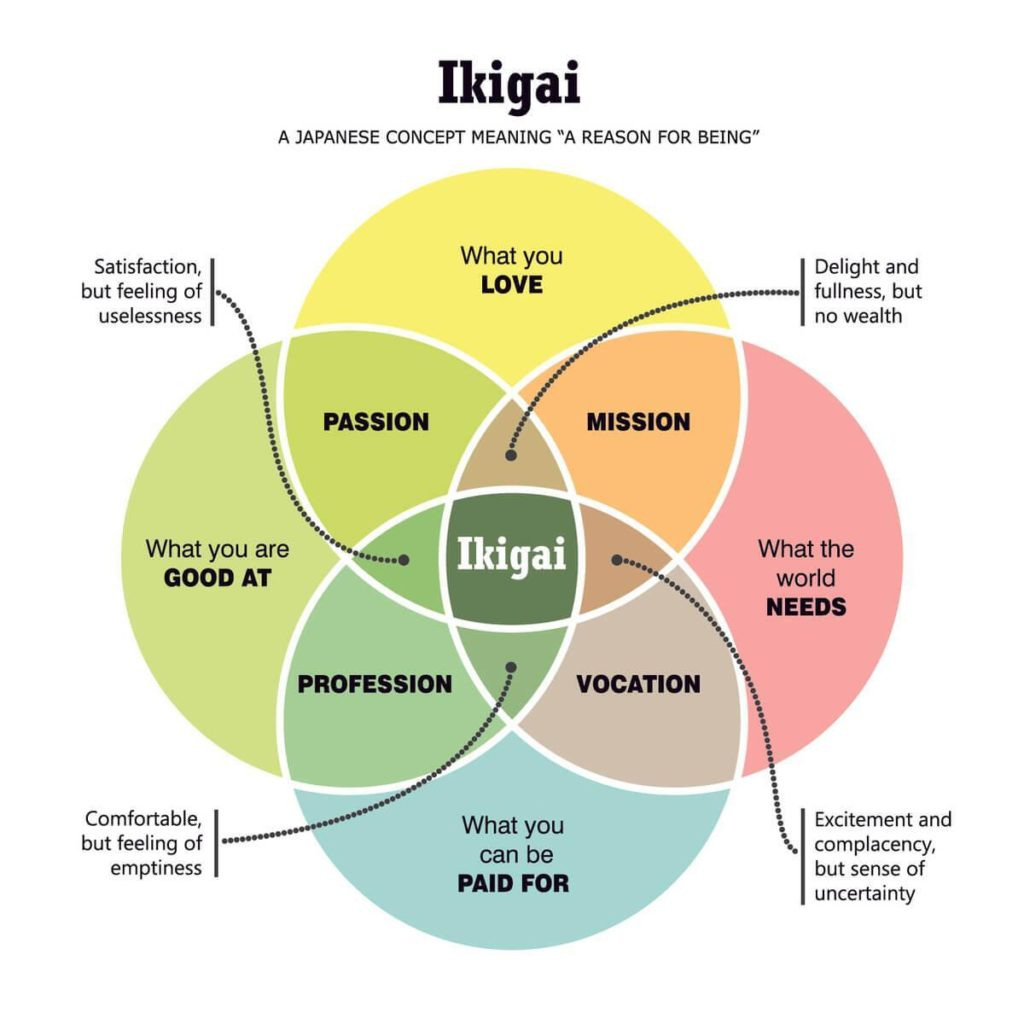
Principle #1: Ikigai
Iki = life/alive, gai = a meaning for
Ikigai is your raison d'être, your reason or justification for existence.
It’s why you wake up in the morning, the motivating force that gives you a sense of purpose and reason for living. Ikigai sits at the intersection of four criteria:
Do what you love.
Do what you’re good at.
Do what the world needs.
Do what you can be paid for.
Principle #2: Kaizen
Kai = change, zen = good
Kaizen means to strive for constant and never-ending improvement.
By focusing on small improvements, you can become 1% better every day. Small daily wins stack up and compound exponentially over time. Whether it’s strong investing habits, a daily exercise practice, or sharpening a career skill, small efforts repeated consistently build massive results in the long run.
But more importantly than any outcome kaizen can help us achieve, a focus on constant improvement shifts our focus off the outcome and onto the process. The richest and most joyous moments of our lives — relationships, fitness, career, art, and hobbies — exist in the process.
An outcome is a fleeting moment we often fail to savor before setting our ambitions on the next goal.
The process is life.
Principle #3: Shoshin
Sho = beginner, shin = mind
“If your mind is empty… it is open to everything. In the beginner's mind there are many possibilities, but in the expert's mind there are few.”
— Shunryu Suzuki in Zen Mind, Beginner's Mind
Shoshin is beginner’s mind.
Experts who succumb to closed-mindedness and hubris are at a disadvantage compared to those who can maintain an attitude of openness and eagerness and drop any preconceptions or expectations.
